Thief Ants

Identification

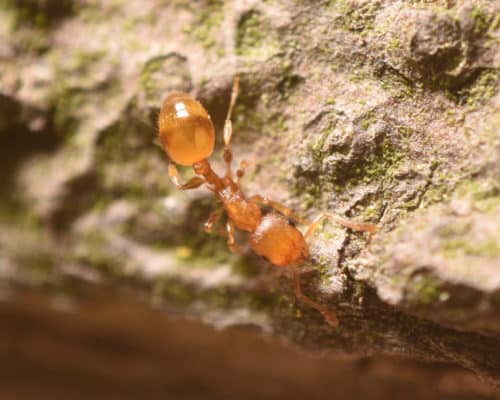
Thief ants are among the smallest of all household ants coming in at about 1.5 mm to 2.2 mm long. They get their name from their habit of nesting near or even inside of other nests. They rob these nests of food as well as larvae and pupae. They are pale yellowish to light or dark brown in color and are found throughout most of the Eastern United States.

BIOLOGY

An interesting ant characteristic is that colonies tend to be smaller than those of other ant species containing only a few hundred up to several thousand workers, but can contain many queens. Thief ants are often confused with pharaoh ants, although they differ in characteristics. These ants are also referred to as “grease ants” or “sugar ants” because of their taste for greasy foods and sweet treats. Thief ants will also feed on dead rats and mice, therefore, they might carry disease-inducing organisms to human food. They may also serve as hosts for tapeworm.


Understanding the lifespan of an ant can offer key insights into their colony behavior, helping pest professionals create more targeted control plans.


Thief Ants

HABITS

Inside, these ants nest in small crevices and in woodwork and masonry. They will wander throughout a building in search of food, but forage in trails. They prefer high protein content and feed on meat, bread, fruit, animal fats, oils, nuts, and dairy products but they will readily feed on sweets. When outside they will nest in exposed soil or under objects, in trash, rotten wood and cavities in trees. Although thief ants are very small, their infestations are noticeable. Homeowners may see a trail of thief ants in their home if they have an infestation. This species is also known to leave trails from a food source to their nest. Once they get inside, these intruders are commonly found foraging for food in kitchens, nesting in small spaces like cabinet voids and wall crevices, as well as behind baseboards and underneath countertops.

CONTROL

Locating the nest is critical in the treatment of thief ants; however, they are often difficult to locate. The best method of thief ant control is to work with a licensed pest professional to create and implement a custom treatment and management plan. There are some additional steps homeowners can take to stop the problem before it occurs.


To help prevent thief ants, it’s crucial to eliminate all access to food and water sources. Make sure to clean up any food crumbs and stop any leaky fixtures. Homeowners should also inspect the home for any small cracks and crevices in the foundation or exterior walls, and seal them up. These cracks provide easy access for ants to gain entry to the home.


Curious homeowners often wonder how long do ants live—a question that’s especially relevant when considering how quickly infestations can return if nests aren’t eliminated.

Common ant species

Pitfalls of Household Ant Control

Household Ant Control pitfalls Ants may seem innocent enough. After all, they are very small and most of them aren’t harmful. Even so, attempting to provide your own household ant control is very risky. We know it can be tempting to be your own ant exterminator in Connecticut, but we

Read More »

Ant Facts: Ant Characteristics You Need to Know

Learning about ant characteristics and their behaviors can help homeowners and businesses protect against persistent ant infestations. Why Understanding Ant Characteristics  Matters Ants are some of the most common household pests. There are more than 10,000 species of ants worldwide, over 1,000 of which live in the United States. Chances

Read More »
Close-up of a dead ant, possibly one of the exploding ants species, lying on its side against a rough, light-colored surface. The image is slightly blurred around the edges.

New Species of Self-Exploding Ant Discovered in Borneo

Colobopsis Explodens: Exploding Ants Unveiled in Borneo Discover the fascinating world of exploding ants, their extraordinary defense behavior, and why understanding their biology offers deeper insight into the complexity of ant species. About Colobopsis Explodens You know all about carpenter ants and sugar ants, but chances are you haven’t heard

Read More »

Richland Pest & Bee Control offers professional ant control to homes and businesses throughout Connecticut including (but not limited to): Avon, Bristol, Coventry, Cromwell, East Hartford, East Haven, East Windsor, Farmington Valley, Hamden, Hartford, Hebron, Manchester, Meriden, Naugatuck, New Britain, New Hartford, New Haven, North Haven, Shelton, Southbury, Southington, Stafford, Suffield, Tolland, Trumbull, Vernon, Wallingford, Waterbury, West Hartford, West Haven, Windsor, Windsor Locks, Woodbury . Look for us in your town!