Table of Contents
ToggleCarpenter bees are among the earliest signs that warm weather has arrived. These large, solitary bees are often misunderstood but can pose significant risks if left unmanaged. Understanding their behavior and impact is important for homeowners.
One of the surest signs of warm weather is the arrival of carpenter bees. Each year, the adults will over-winter in abandoned nests, emerging in the spring to feed on nectar. We get a lot of phone calls about these particular pests, and for good reason! They can become not only a serious nuisance, but can pose a threat to your property as well. Read on to learn a little bit more about carpenter bees, and what makes them different than your average bee.
Carpenter bees are solitary, and therefore do not live in nests or colonies that other bees are known for. In fact, each individual hole you can see them coming in and out of is typically a separate nest. Females will bore holes into the wood using their mandibles. They will go straight in, creating a hole the same diameter as their body, and then turn to follow the grain of the wood. Unlike wasps, carpenter bees have been known to reuse existing nests, also called galleries. The females will create open spaces within these galleries, known as cells, and will lay her eggs here.
Recognizing early signs of carpenter bee activity can help prevent extensive damage. Watch for perfectly round holes in wood, sawdust piles, or large bees hovering near eaves, decks, and fences.
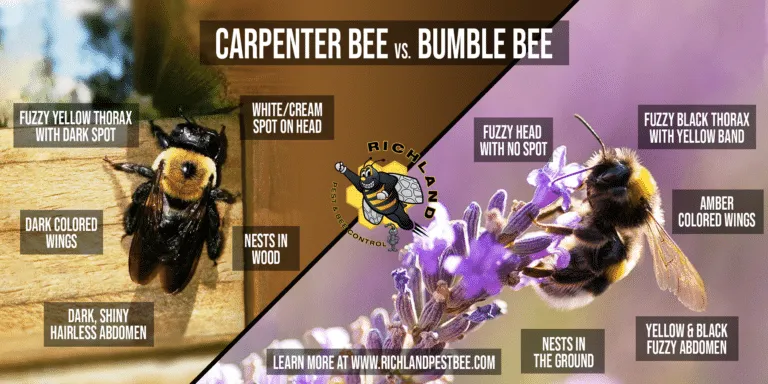
Carpenter bees are often confused with bumblebees, but you can distinguish them by their shiny, hairless black abdomens and larger size. Males have a yellow patch on their face, while females are entirely black.
A sometimes surprising fact, male carpenter bees lack the ability to sting. However, they will show signs of aggression when they are trying to protect their territory. They are simply showboating and trying to get you to leave by hovering in your face or diving towards you. In reality, they can’t harm you. Females on the other hand, do have a pretty potent sting, but they will rarely use it.
The female carpenter bee constructs tunnels to lay eggs, providing each larva with pollen and nectar as a food source. Over time, tunnels can grow larger and longer with each generation reusing the nests.
Carpenter bees are a serious property threat, and can cause structural damage over time if they are allowed to go untreated. They have a preference for soft, untreated wood for building their galleries. Over time, these galleries can extend up to 10ft long, which can easily compromise the integrity of the structure depending on where the nest is located. Imagine taking a very long drill bit, and drilling a quarter inch round hole all the way along the length of your structural support beam in your home. Now you can see why this may become a major issue.
Aside from the internal damage caused by tunneling, carpenter bee activity can attract woodpeckers that feed on the larvae, compounding the destruction to wood structures.
Due to their preference for bare, untreated wood, painting or staining wood can sometimes deter them. That is not a foolproof method though, and carpenter bees will still attack painted or treated wood in many cases. Make sure to routinely inspect your property for signs of activity. Contact us online or at 1-800-308-9126 if you suspect an infestation. Bee control can be tricky for homeowners and we have the tools and experience needed to make it a safe and simple fix for you. We can treat your existing nests and provide a preventative treatment to stop them from returning throughout the season. Learn more about our preventative Bee Barrier here.
Sealing cracks and holes, replacing weathered wood, and using vinyl or metal materials for outdoor construction are additional strategies to deter carpenter bees.
Contact richlandpestbee.com online or at 1-800-308-9126 if you suspect an infestation. Bee control can be tricky for homeowners and we have the tools and experience needed to make it a safe and simple fix for you. We can treat your existing nests and provide a preventative treatment to stop them from returning throughout the season. Learn more about our preventative Bee Barrier here.

Richland Pest & Bee Control is a family-owned pest management company serving Connecticut and Western Massachusetts for over 40 years. Known for their expertise and 5-star customer service, they offer reliable solutions for stinging insects, rodents, and other pests, ensuring homes and businesses stay pest-free.
In alignment with competitor insights, homeowners consistently trust professional extermination because:
This expanded coverage mirrors the comprehensive service focus found on high-ranking competitor pages.
Click through the questions below to learn more about carpenter bees control services options from Richland Pest & Bee Control. If you have any additional questions, feel free to reach out by contacting us online, or giving us a call at 1-800-308-9126.
Carpenter bees are a type of bee that burrow into wood in order to create nests.
Carpenter bees are not usually dangerous to humans, as they are not aggressive and do not sting unless provoked.
The most obvious sign of carpenter bees is the presence of small holes in wood surfaces, as well as the sound of buzzing coming from within the wood.
It is possible to get rid of carpenter bees on your own using certain insecticides, but it is often safer and more effective to hire a professional pest control service.
Carpenter bees can cause significant damage to wooden structures if left unchecked, as their burrowing can weaken the wood and make it more susceptible to rot and other types of damage.
Preventative measures include painting or staining wood surfaces, filling in existing holes with wood filler, and using treated lumber for outdoor construction projects.
Contact a professional pest control company for treatment options, which may include insecticide sprays, dusts, or foam.
It is recommended that homeowners have their homes inspected for carpenter bees at least once a year, preferably in the spring when the bees are most active.
Carpenter bees are attracted to unpainted or unstained softwoods, such as pine, cedar, and redwood.
Pest control companies can help with a wide range of pests, including ants, termites, rodents, and bed bugs.
The best carpenter bee control will depend on the severity of the infestation and the specific circumstances of the property. A professional pest control company can provide a customized plan for carpenter bee control that may include insecticide treatments, sealing off access points, and pest prevention measures.
Carpenter bee control can be achieved through a combination of insecticide treatments, sealing off access points, and preventative measures such as painting or staining wood surfaces and using treated lumber for outdoor construction projects.
To keep carpenter bees away, it is recommended to paint or stain wooden surfaces, fill in existing holes with wood filler, and use treated lumber for outdoor construction projects. Additionally, providing alternative nesting sites such as bee boxes may discourage carpenter bees from nesting in unwanted areas.